Pearson Edexcel · GCSE · English Literature
Writing – Accurate Standard English
Mastering Assessment Objective 4 (AO4) is the secret weapon for GCSE English Literature success. This guide reveals how to consistently secure those 4 crucial marks for spelling, punctuation, and grammar, transforming your analytical writing from clear to sophisticated.
- 4 min read
- 2 worked examples
- 4 practice questions
- 8 key terms
Study Notes
Overview
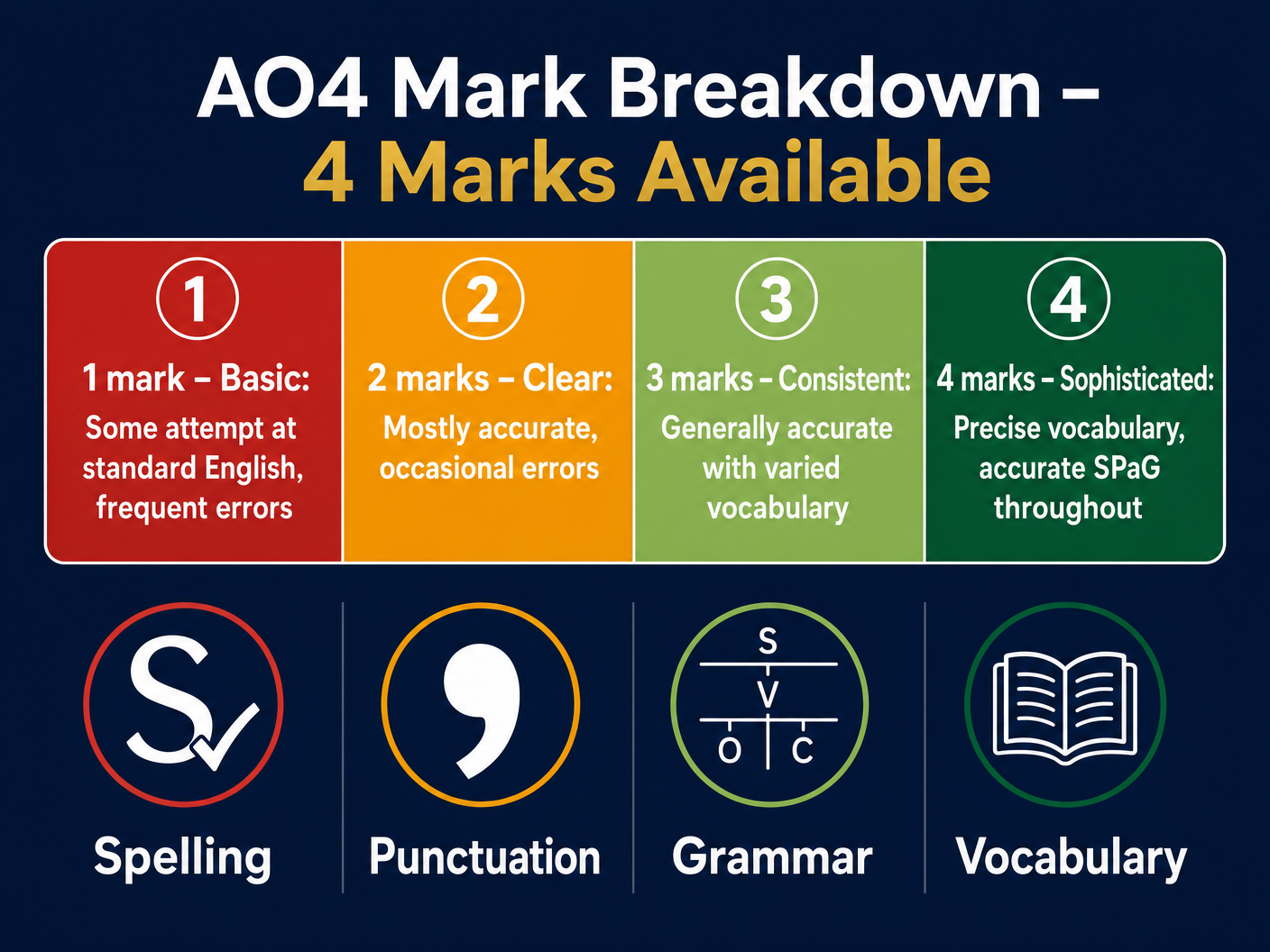
Assessment Objective 4 (AO4) requires candidates to use a range of vocabulary and sentence structures for clarity, purpose, and effect, with accurate spelling and punctuation. It is worth 4 marks on every extended response in the Edexcel GCSE English Literature specification. While 4 marks may seem small, they often represent the difference between grade boundaries. More importantly, writing in accurate Standard English enhances your AO1 and AO2 marks by ensuring your interpretation and analysis are communicated with absolute clarity. Examiners reward candidates who write precisely, analytically, and formally.
The Four Core AO4 Skills
1. Vocabulary
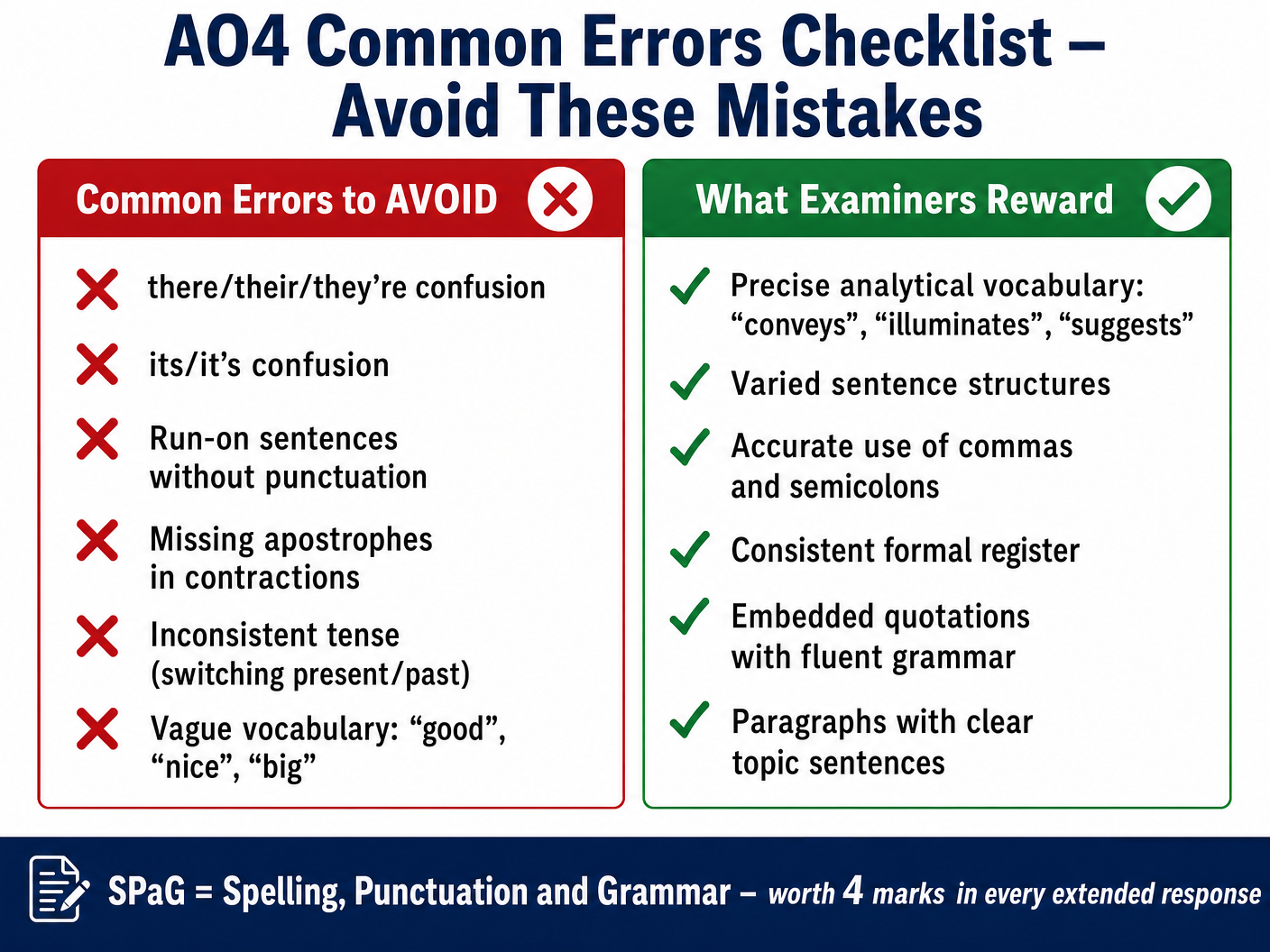
Examiners reward a range of vocabulary used for clarity, purpose, and effect. In literature responses, this means employing precise analytical verbs and sophisticated adjectives. Rather than writing "the writer shows the character is bad," a strong candidate writes "the writer constructs the character as a figure of menace." Build a bank of analytical verbs such as conveys, illuminates, suggests, implies, reinforces, and juxtaposes.
2. Sentence Construction
High-scoring responses demonstrate varied and controlled sentence structures. This involves balancing complex sentences that develop a nuanced argument with short, punchy sentences for emphasis. For example: "Through this metaphor, Dickens exposes the moral bankruptcy of Victorian society. The effect is devastating." The short final sentence lands with impact.
3. Accurate Spelling
Spelling errors distract the examiner and cost marks. Candidates must ensure accurate spelling of subject-specific terminology (metaphor, juxtaposition, ambiguous, protagonist) and commonly confused words (there/their/they're, affect/effect).
4. Accurate Punctuation
Accurate punctuation is vital for clarity. Key rules for literature essays include: using commas after introductory clauses, employing semicolons to link closely related independent clauses, mastering the apostrophe for both possession and contraction, and accurately punctuating embedded quotations.
Structuring Analytical Paragraphs
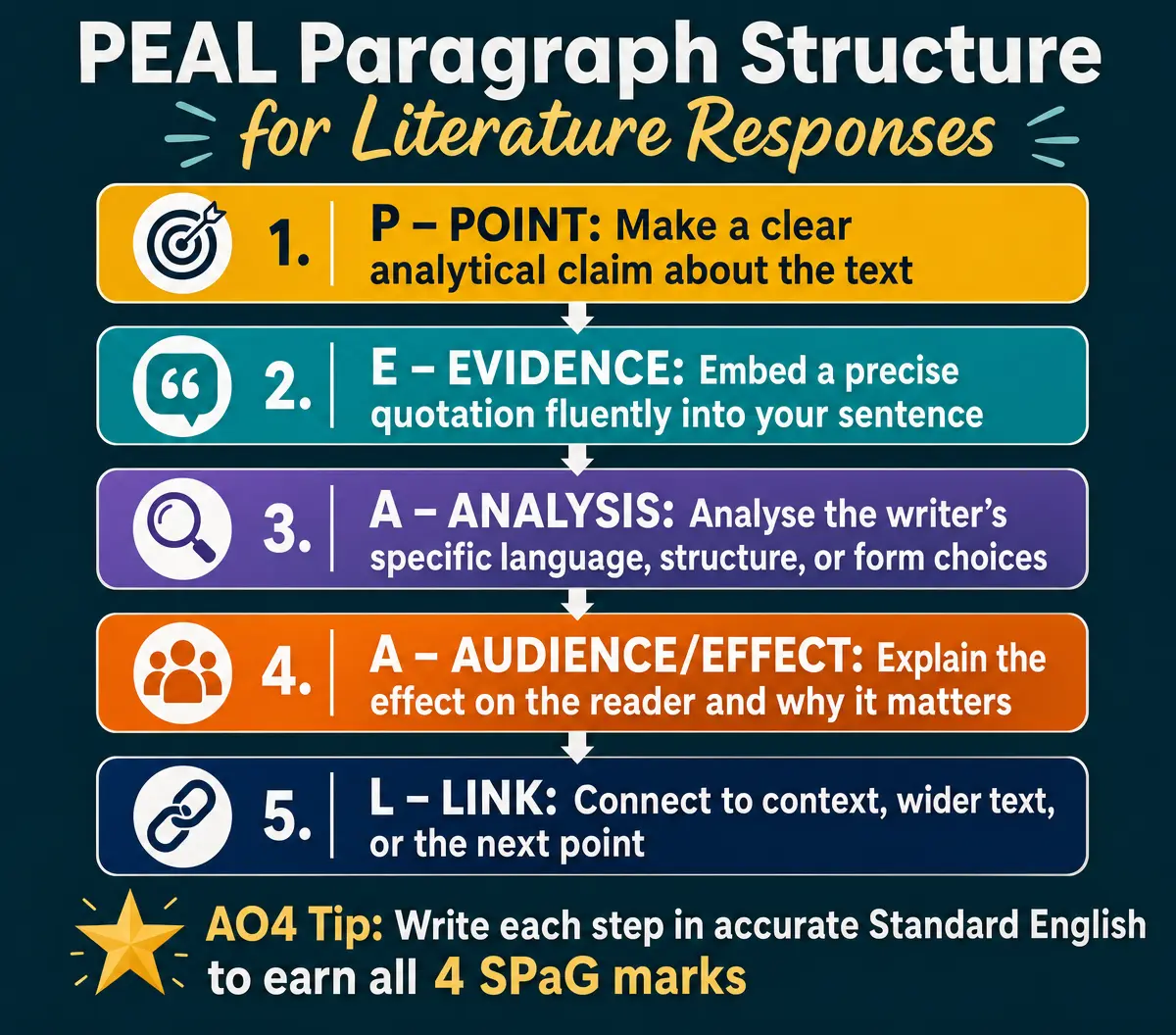
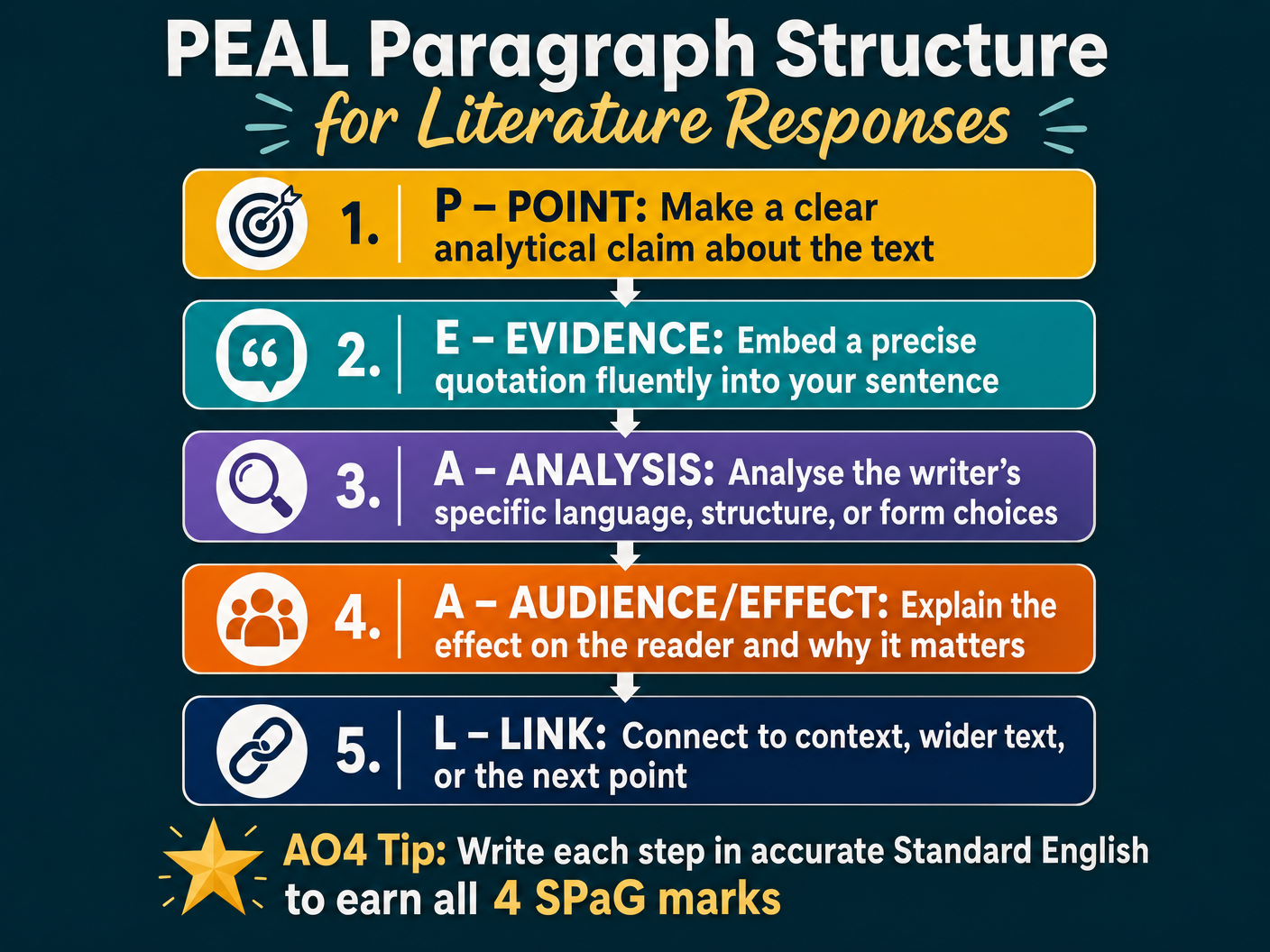
The most effective structure for a literature paragraph is PEAL, executed in formal Standard English:
P – Point: Make a clear, conceptualised claim. Avoid vague openers. (e.g., "Dickens presents Scrooge as a figure of deliberate social isolation...")
E – Evidence: Embed quotations fluently into your sentence grammar. Do not drop them in abruptly. (e.g., "...using the relentless accumulation of present participles—'squeezing, wrenching, grasping'—to enact his greed.")
A – Analysis: Name the writer's method accurately and explain its specific effect. Avoid mere feature-spotting.
A – Audience/Effect: Explain how the method shapes the reader's response and why it matters to the text's overall meaning.
L – Link: Connect your paragraph to the wider text, context, or your next point to maintain a coherent argument.
Common Pitfalls and Exam Strategy
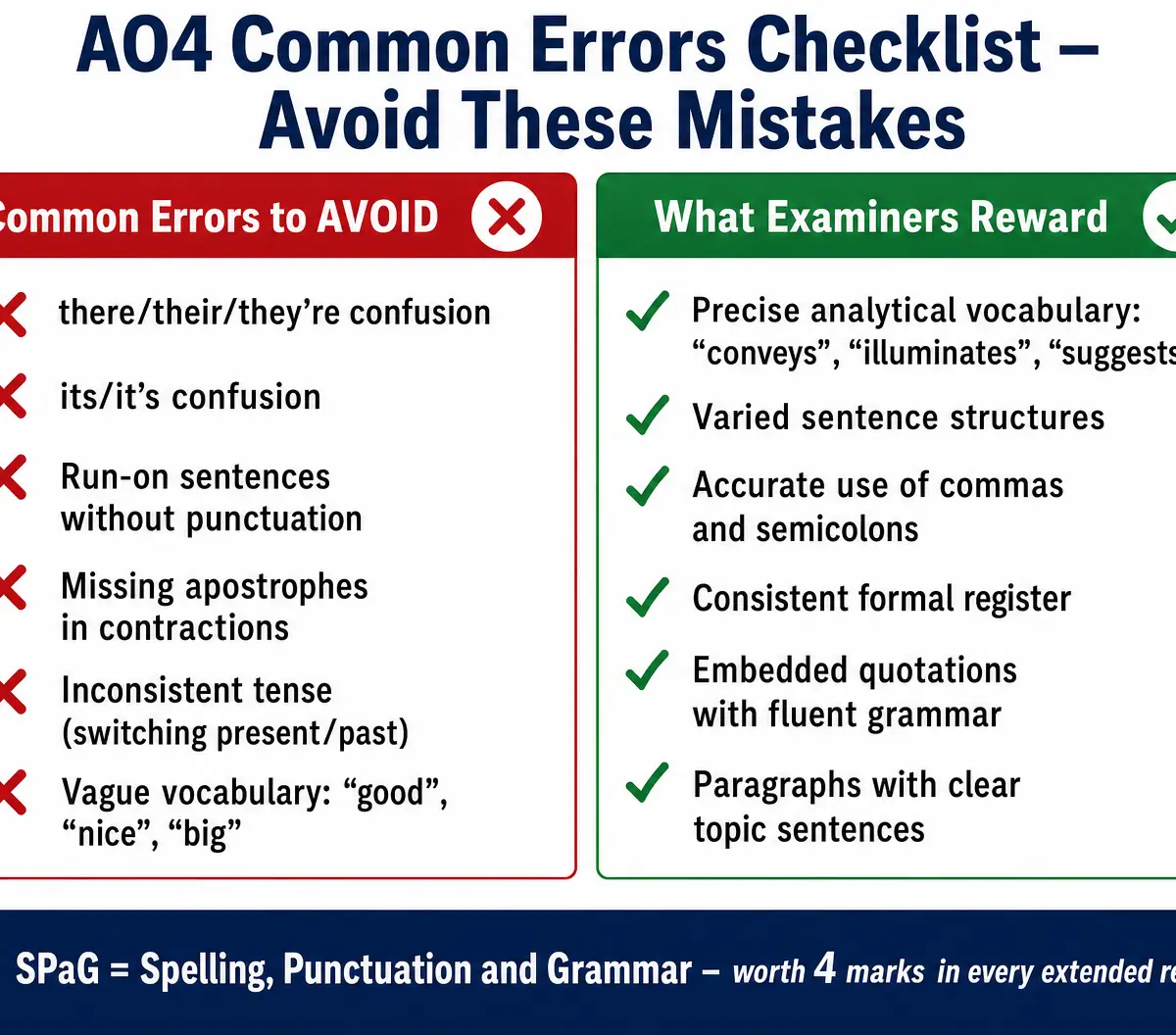
Candidates frequently lose AO4 marks through avoidable errors. Always write in the literary present tense ("Shakespeare presents", not "Shakespeare presented"). Avoid contractions in formal writing (use "it is" instead of "it's"). Eliminate vague vocabulary like "good", "nice", or "shows". Crucially, leave two minutes at the end of every response to proofread specifically for spelling, punctuation, and tense consistency.
Listen to the AO4 Masterclass Podcast

Listen to our 10-minute masterclass covering the core skills, paragraph structures, and common mistakes, complete with a quick-fire recall quiz.
Visual Resources
3 diagrams and illustrations
Interactive Diagrams
1 interactive diagram to visualise key concepts
Conceptual Flow Outline
Progression of AO4 Marks
Worked Examples
2 worked examples — open one to explore the question and available guidance.
Practice Questions
Test your understanding — click to reveal model answers
Read the following student paragraph. Rewrite it to improve the AO4 marks, focusing on vocabulary, tense consistency, and embedding the quotation: 'The writer showed that the weather was bad. He said "the wind howled like a beast". This shows that the weather was scary and it made the character feel sad.'
Hint: Upgrade 'showed' and 'bad'. Change to present tense. Embed the quote. Upgrade 'scary' and 'sad'.
Identify and correct the four SPaG errors in this sentence: 'The writers use of metaphors effect the reader deeply, its clear that their trying to create tension.'
Hint: Look for possession, commonly confused words (affect/effect), and contractions.
Write a PEAL paragraph analysing a quotation of your choice from any text you study. Focus entirely on securing 4/4 for AO4.
Hint: Ensure your point is conceptual, your quote is embedded, your analysis uses accurate terminology, and your vocabulary is sophisticated.
Upgrade these four basic verbs to precise analytical verbs: 1. Shows, 2. Says, 3. Makes, 4. Gives.
Hint: Think about what the writer is *deliberately doing* to the reader or the text.